Jay D. TassonPhysics and Astronomy DepartmentCarleton College |
![]() |
Contact InformationOffice: Olin Hall 337 Office Hours: Monday 2:00-3:00 pm, by
appointment, or any time you find me. Just stop by! Email: jtasson[at]carleton.edu |
Olin 02
M,W: 12:30-1:40 pm; F: 1:10-2:10 pm
Olin 301
T: 1:00 pm-5:00 pm
A diverse set of opportunities exist for students to work with me
on projects related to relativity testing (testing Lorentz symmetry).
The opportunities could
involve a variety of activities ranging from data analysis to paper and
pencil theory and span a variety of areas of physics. There are also
projects suited to a variety of backgrounds and skill levels. Also see
the department
special projects page. For more information about relativity
testing, see FAQ about
CPT and Lorentz violation or the publications and animations of
recent results below.
|
|
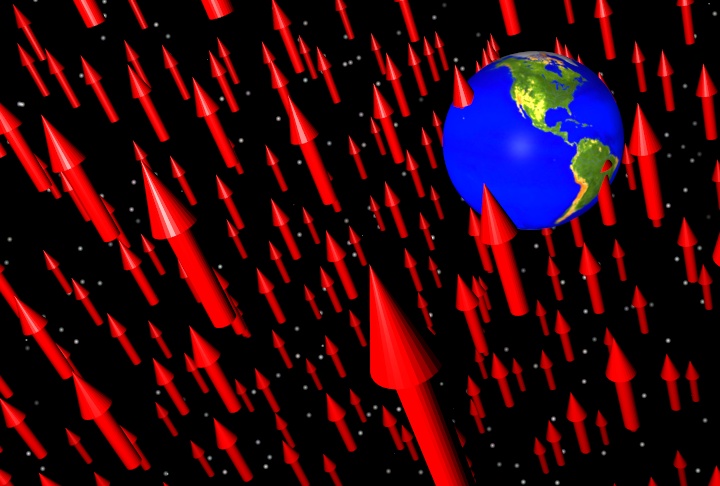
The potential relativity violations considered in Phys. Rev. Lett. 102, 010402 (2009) change the gravitational properties of an object according to its motion. One striking effect results from the revolution of the Earth around the Sun. For example, the rate at which objects fall to the Earth can depend on the season. This is illustrated in the animation at left. The Earth is shown moving around the Sun in a background of red arrows representing the relativity violations. The motion of the Earth and objects like an apple aligns differently with the arrows in the summer and winter, which causes identical apples to fall at different rates in the two seasons. There is also a similar but smaller day-night effect due to the rotation of the Earth. The cover story for the April 15, 2009 issue of New Scientist provides additional lay discussion of these effects. |
|
|
Einstein's theory of General Relativity is based on the idea that space and time are curved. An additional warping of space and time that is popular in some alternative theories of gravity is known as Torsion. The work published in Phys. Rev. Lett. 100, 111102 (2008) provides the first measurement of potential effects arising from 15 of the 24 quantities that describe torsion and provides improved sensitivity to the effects of 4 more. The paper develops an analogy between the effects of spacetime torsion and the effects of tiny deviations from the laws of Special Relativity. Such motions have been excluded at an astounding level in experiments at the Harvard-Smithsonian Center for Astrophysics in Cambridge, Massachusetts and the University of Washington in Seattle The University of Washington group uses a pendulum containing a large number of aligned electron spins to magnify these effects. The apparatus can measure changes in the rotation of the pendulum smaller than 0.000001 degrees. A simplified illustration of the motion of such a device is provided by the animation at left. The complementary approach used in the Harvard-Smithsonian experiment involves precision studies of microwaves emitted from a helium-xenon maser. This permits measurements of changes in the spin orientation of neutrons at levels comparable to the measurements made on the electron by the Washington group. |